Nova Scotia Power is bringing the power lines that march through the woods out to the road.
The lines will be easier to repair if they go down in a storm. And some waterfront properties will no longer have lines spoiling their view.
So we’re getting new power poles.
Nova Scotia Power workers and new power poles
Poles made from a variety of wood species are used. Some come from quite a distance. Near the water they put cedar from the west coast. Further inland they use creosote-treated pine from down the Eastern Seaboard where pine grows taller, straighter and faster. They also use Douglas Fir. Apparently the Nova Scotian pine that was once prized for masts of sailing ships by the Royal Navy is no longer good enough.
Something else to add to our carbon footprint.
“Why can’t they just bury the power lines?” you might ask. The answer, as for many questions about rural Nova Scotia, lies in the low population density. It just costs too much for the number of people who live here. So lines criss-crossing the road are just a fact of life in rural areas. We might as well embrace them, even photographically, like the fog!
The same factors that make Nova Scotia a wonderful place to live also determine its limitations. C’est la vie.
Strolling along the waterfront last Friday, we heard a cool jazz piano, accompanied by bass and drums, coming from the Festival Tent being set up on Lower Water St. at Salter St. extension. The place was crawling with volunteers adjusting banners and chairs, getting things ready for the show to start at 8 pm. They offered us a program, but, alas, we were on our way to see the Tattoo.
Setting up the Festival Tent for the Halifax Jazz Festival
The Halifax Jazz Festival continues until Saturday, July 16th in various venues around town.
“What is it?” he kept asking before we went. “It’s … a show,” I said, inadequately.
It’s hard to describe the Tattoo; if you haven’t seen it, I’ll refer you to its own website, which says it is “the world’s largest indoor show…. featuring over 2,000 world-class Canadian and international military and civilian performers … a fast-paced, two-and-a-half hour family show featuring music, dance, acrobatics, drama and comedy in a number of innovative acts.”
Bands to the rafters and the choir during the finale
Originally modeled on the Edinburgh Tattoo in Scotland, the Nova Scotia Tattoo was first staged in 1979 and featured primarily military acts.
Over the years, many civilian acts have been added, including guest performers from all over the world.
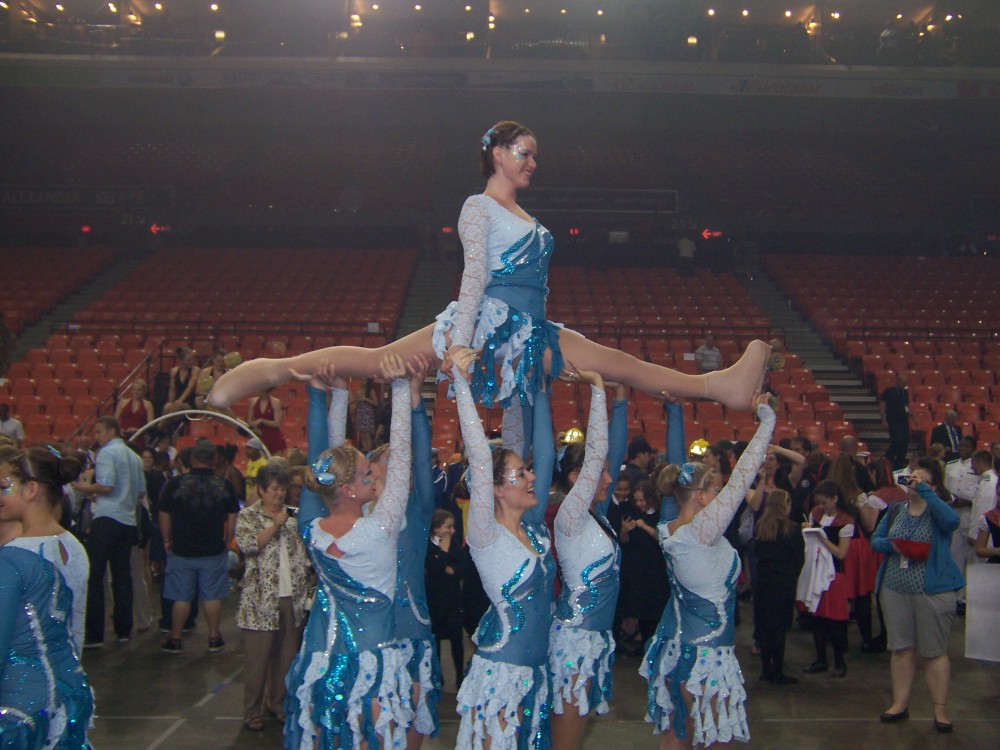
In common with the military marching bands and demonstrations of physical prowess, virtually all the acts involved precision teamwork.
Estonian roller skaters pose for photos after the show
We saw a fabulous precision roller skating team from Estonia, the French Guarde Républicaine motorcycle ballet, a German gym wheel team, and of course, Scottish Highland Dancers from Nova Scotia and from Australia. The latter group mixed the traditional strict forms of Highland Dance with tribal rhythms and modern innovations, which I found intriguing, having grown up partly in Antigonish where many kids took Highland Dance lessons.
The highest level of millisecond exactness was displayed by an all-female New Zealand drill team.
Talentholdet's innovative rope skipping
The loosest group was the Danish gymnastic troupe Talentholdet whose playful exuberance contrasted refreshingly with the strict discipline of the other acts while performing jaw-dropping feats of tumbling.
Even the tightest military bands had their comic routines to keep us entertained.
Musically, it was impressive that the many brass bands, the bagpipe bands, the choir and the soloists, spread across the width of the Metro Centre, could play in ensemble (almost all the time) – another testament to discipline and talent. Quite the sound!
Notably most of the civilian performers were female – dance troupes in particular, and while there were many women in the military bands, you had to look closely to distinguish them in their uniforms.
The show has a strong vein of patriotism and support for the troops, in their current mission of training the Afghan army now that Canada’s combat role has ended. Included in the honours are police, firefighters, emergency medical services and other first responders who “serve and protect”.
Altogether, the Tattoo is a huge community effort supported by many volunteers. The audience contained people from every province in Canada and many from the USA.
It’s a show that just about everyone should experience at least once.
I just scored a truckload of chipped branches from a road crew trimming the area around the phone and power lines on our road.
They were happy not to have to cart it back to Halifax, where the truck was headed, so I suppose I saved the contractor a bit of money in diesel.
But I feel like the real winner. I was thrilled to get this much steaming organic matter, a nice mix of “browns and greens” (branches and leaves) which avid composters know to be the ingredients of the slow fire in the middle of a compost heap that produces all that nice gardener’s gold that makes gardens grow.
I’m spreading it over future garden beds. First, I covered the sod with overlapping layers of corrugated cardboard (from behind a grocery store) to smother grass and weeds. Under the cardboard are oak leaves that someone was throwing away. (More free organic matter!) The woodchips go on top of the cardboard in a thick layer. Later I’ll add some manure (which I’ll have to pay for).
In a year or two, the beds will be ready for annual vegetables. The soil will be deeper and contain more organic matter, which it sorely needs. I get out of breaking sod, which is the physically hardest part of gardening. The worms will do the work for me.
Spreading woodchips on future garden beds.
The soil here is sandy and poor – not like the rich drumlin soil of the LaHave River Valley nearby. It needs lots of organic material to become productive for gardening.
Fortunately, Nova Scotia is a leader in “waste” management. Even if I had not intercepted this truckload of material which is so valuable to me, it would have been composted, not buried in a landfill.